

Medical imaging has become an essential part of modern healthcare, helping doctors diagnose injuries, diseases, and internal conditions without surgery. Among the most commonly used imaging tests is Magnetic Resonance Imaging (MRI). If your doctor has recommended one, your first question is probably how much does an MRI cost. The answer isn’t as straightforward as many people expect because MRI prices vary depending on several factors, including the body part being scanned, the healthcare provider, your location, and whether you have health insurance.
In the United States, MRI costs can range from a few hundred dollars to several thousand dollars. While some patients pay less than $400 at independent imaging centers, others may receive bills exceeding $4,000 after visiting a hospital. Understanding why these price differences exist can help you make informed decisions and potentially save hundreds—or even thousands—of dollars.
This complete 2026 guide explains everything you need to know about MRI costs, insurance coverage, pricing factors, and practical ways to reduce your medical expenses.
What Is an MRI and Why Might You Need One?
Magnetic Resonance Imaging, commonly known as MRI, is a non-invasive diagnostic scan that uses powerful magnets and radio waves to create detailed images of organs, muscles, nerves, bones, and soft tissues. Unlike CT scans or X-rays, MRI does not use ionizing radiation, making it a safer option for repeated imaging in many situations.
Doctors recommend MRI scans for diagnosing numerous conditions, including sports injuries, torn ligaments, herniated discs, spinal disorders, brain abnormalities, tumors, joint damage, multiple sclerosis, stroke, internal bleeding, and heart conditions. MRI is also frequently used to monitor ongoing treatments or evaluate whether surgeries have been successful.
The complexity of MRI technology explains why these scans can be relatively expensive. MRI machines cost millions of dollars to purchase and maintain, require specialized technicians, and involve highly trained radiologists who interpret the results.
How Much Does an MRI Cost in 2026?
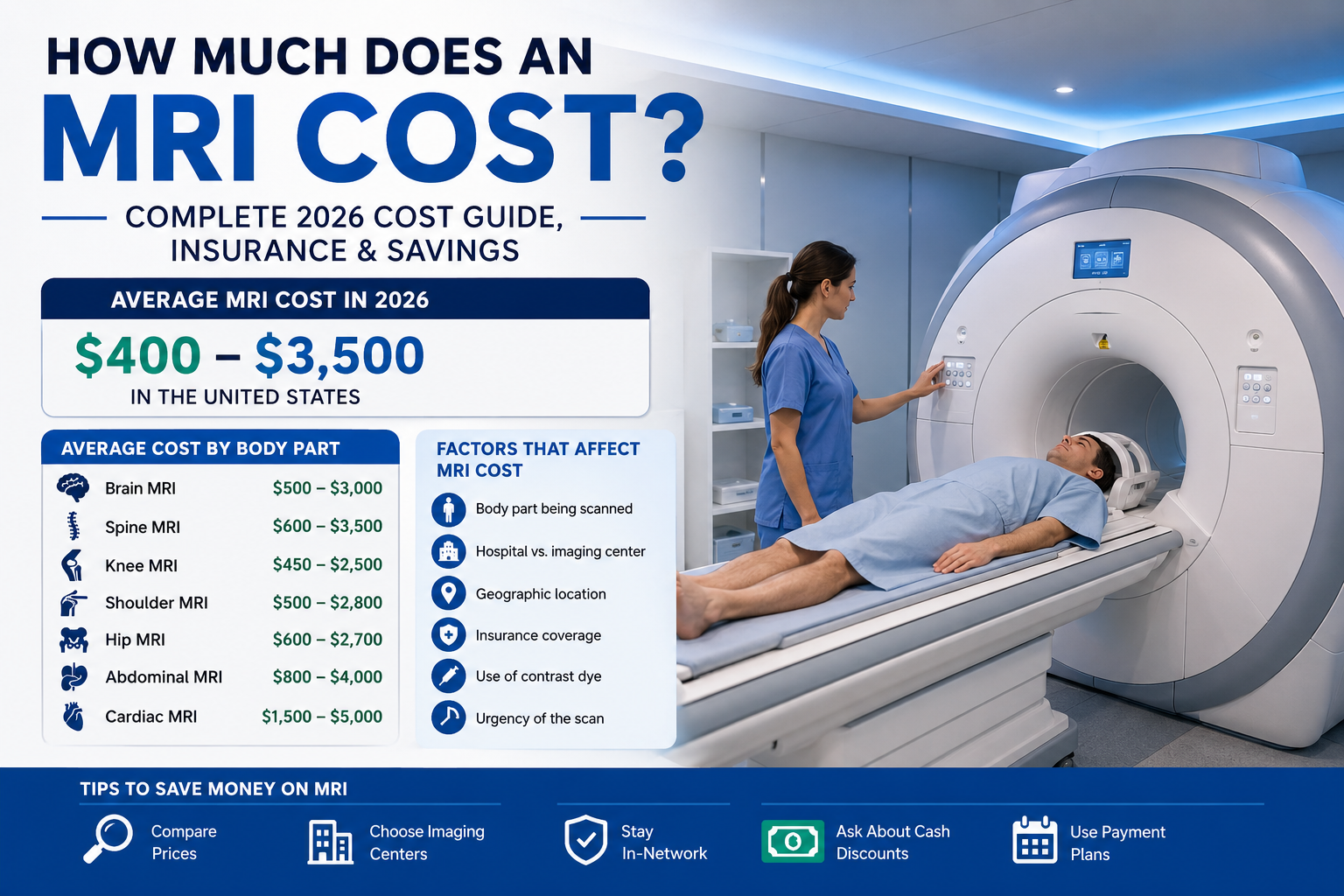
The average MRI cost in the United States in 2026 typically falls between $400 and $3,500, although certain specialized scans may cost even more.
Here’s a general price breakdown:
| MRI Type | Average Cost |
|---|---|
| Brain MRI | $500–$3,000 |
| Spine MRI | $600–$3,500 |
| Knee MRI | $450–$2,500 |
| Shoulder MRI | $500–$2,800 |
| Hip MRI | $600–$2,700 |
| Abdominal MRI | $800–$4,000 |
| Cardiac MRI | $1,500–$5,000 |
Patients often assume MRI prices are standardized across hospitals, but that’s far from reality. One imaging center may charge $500 for the same scan another hospital bills at $2,500. The difference usually comes down to facility fees, equipment costs, local competition, and billing practices.
Independent outpatient imaging centers generally offer the most affordable MRI prices because they have lower operating costs than hospitals.
Factors That Affect MRI Costs
Many variables determine the final price you’ll pay for an MRI. Understanding these factors allows you to compare providers and avoid unexpected medical bills.
1. Body Part Being Scanned
Some MRI scans require more imaging sequences and longer scan times than others. For example, a simple knee MRI usually costs much less than a cardiac MRI or full spinal examination.
2. Hospital vs. Imaging Center
Hospitals generally charge higher prices because they include facility fees, emergency services, and administrative costs. Independent imaging centers usually specialize in diagnostic imaging and therefore offer lower pricing.
3. Geographic Location
Healthcare costs vary dramatically across states and cities. MRI scans in major metropolitan areas tend to cost significantly more than those in smaller towns or suburban imaging facilities.
4. Insurance Coverage
Whether you have insurance plays one of the biggest roles in determining your out-of-pocket cost. Insurance companies negotiate discounted rates with providers, meaning insured patients often pay substantially less than uninsured individuals.
5. Contrast Dye
Some MRI scans require contrast material, usually gadolinium, to improve image quality. Adding contrast increases both the complexity and overall cost of the examination.
6. Urgency
Emergency MRI scans performed in hospital emergency departments often cost considerably more than scheduled outpatient appointments.
How Much Does an MRI Cost Without Insurance?
For uninsured patients, MRI costs can feel overwhelming. Without negotiated insurance rates, individuals may receive bills ranging from $1,000 to over $4,000, depending on the provider.
Fortunately, paying full price is rarely your only option.
Many imaging centers offer:
- Self-pay discounts
- Cash-pay pricing
- Payment plans
- Financial assistance
- Promotional pricing
- Seasonal discounts
Some independent imaging centers advertise flat-rate MRI pricing as low as $300–$600, making it worthwhile to compare prices before scheduling your appointment.
Never assume the first quoted price is your only option. Asking about self-pay discounts can reduce your bill by hundreds of dollars.
How Insurance Affects MRI Costs
Health insurance significantly changes what patients actually pay for MRI scans. While your insurance company may be billed several thousand dollars, your personal responsibility often depends on your deductible, copayment, coinsurance, and annual out-of-pocket maximum.
For example, if you’ve already met your deductible, your insurer may cover most of the MRI cost, leaving you responsible for only a small copay. However, if your deductible hasn’t been met, you may need to pay the negotiated rate yourself before insurance contributes.
Many insurance plans also require prior authorization before approving non-emergency MRI scans. Failing to obtain authorization could result in claim denial, leaving you responsible for the full amount.
Before scheduling an MRI, contact your insurance provider and ask:
- Is prior authorization required?
- Which imaging centers are in-network?
- How much of my deductible remains?
- What will my estimated out-of-pocket cost be?
- Does my plan cover contrast-enhanced MRI scans?
Taking these simple steps can prevent expensive surprises after your appointment.
How to Save Money on an MRI
If you’re wondering how much does an MRI cost and looking for ways to lower the bill, the good news is that there are several proven strategies. MRI pricing is not fixed, and many patients save hundreds or even thousands of dollars simply by comparing providers before scheduling an appointment.
Compare Prices Before Booking
Never book the first MRI appointment your doctor recommends without checking prices. Hospitals often charge significantly more than independent imaging centers for the exact same scan. Calling several facilities or using healthcare price comparison websites can reveal major price differences in your area.
Choose an Independent Imaging Center
Outpatient imaging centers usually specialize in MRI, CT, and ultrasound services. Since they don’t have the overhead costs associated with hospitals, they can offer much lower prices while maintaining high-quality imaging equipment and experienced staff.
Stay In-Network
If you have health insurance, always verify that the imaging provider is within your insurance network. Going out of network can dramatically increase your out-of-pocket expenses.
Ask About Cash Discounts
Many providers offer discounted rates for patients paying out of pocket. Some imaging centers reduce prices by 20% to 50% for self-pay patients. It never hurts to ask.
Schedule Only the Recommended Scan
Occasionally, patients request additional scans “just to be safe.” Unless your doctor specifically recommends them, unnecessary imaging only increases healthcare costs without improving diagnosis.
Use Payment Plans
If paying the full amount upfront isn’t possible, ask about interest-free payment plans. Many providers allow patients to spread payments over several months.
MRI Costs by Body Part
The area of the body being scanned has a major impact on the overall cost. More complex scans require longer imaging times and additional image sequences, increasing the final bill.
Brain MRI
Brain MRIs are commonly used to diagnose strokes, tumors, headaches, seizures, multiple sclerosis, and neurological disorders. Typical costs range from $500 to $3,000, depending on whether contrast dye is used.
Spine MRI
Spinal MRIs help identify herniated discs, spinal stenosis, nerve compression, fractures, and chronic back pain. Because the spine is divided into cervical, thoracic, and lumbar regions, scanning multiple sections increases the cost. Prices generally range from $600 to $3,500.
Knee MRI
One of the most common orthopedic scans, knee MRIs detect ligament tears, cartilage damage, meniscus injuries, and arthritis. Prices usually range between $450 and $2,500.
Shoulder MRI
Doctors often recommend shoulder MRIs for rotator cuff injuries, labral tears, and chronic shoulder pain. Typical costs range from $500 to $2,800.
Abdominal MRI
Abdominal imaging is more complex because multiple organs may need evaluation. Costs generally range from $800 to $4,000.
Cardiac MRI
Heart MRIs require specialized equipment and expertise, making them among the most expensive MRI procedures. Costs frequently range from $1,500 to over $5,000.
Hospital MRI vs. Imaging Center: Which Is Better?
Patients often assume hospitals always provide the best imaging services, but that’s not necessarily true.
Hospitals are ideal for emergency situations, trauma cases, and patients who require immediate medical care. However, routine outpatient MRI scans can often be completed at accredited imaging centers for substantially lower prices.
Hospital Advantages
- Emergency availability
- Access to specialists
- Suitable for complex medical conditions
- Immediate follow-up care
Imaging Center Advantages
- Lower prices
- Faster appointment scheduling
- Shorter waiting times
- Specialized imaging equipment
- Lower facility fees
For non-emergency imaging, many physicians recommend outpatient imaging centers because they provide high-quality scans at much lower costs.
Frequently Asked Questions
How much does an MRI cost without insurance?
Without insurance, MRI costs generally range from $1,000 to $4,000, although some imaging centers offer self-pay prices as low as $300 to $600.
Does insurance cover MRI scans?
Most health insurance plans cover medically necessary MRI scans, but patients may still owe deductibles, copayments, or coinsurance.
Why are MRI prices so different?
MRI pricing varies because of hospital fees, geographic location, insurance contracts, equipment costs, scan complexity, and whether contrast dye is used.
Is an MRI more expensive than a CT scan?
In many cases, yes. MRI scans usually cost more because the equipment is more advanced, the procedure takes longer, and interpretation is often more complex.
Can I negotiate MRI prices?
Yes. Many imaging centers are willing to offer cash discounts, payment plans, or reduced self-pay pricing if you ask before scheduling.
Conclusion
If you’ve been asking how much does an MRI cost, the answer depends on several important factors, including your location, insurance coverage, the body part being scanned, and the facility you choose. While MRI prices in the United States can range anywhere from a few hundred dollars to several thousand dollars, patients who compare providers, stay within their insurance network, and ask about self-pay discounts often save significant amounts of money.
Before scheduling your MRI, spend a little time researching local imaging centers, confirming your insurance benefits, and requesting written cost estimates. These simple steps can help you receive high-quality medical imaging while avoiding unnecessary healthcare expenses. Being an informed patient is one of the best ways to protect both your health and your budget.
FAQs
Q1. How much does an MRI cost in 2026?
Most MRI scans cost between $400 and $3,500, depending on the type of scan and the facility.
Q2. What is the cheapest way to get an MRI?
Using an independent imaging center, staying in-network, and asking for a self-pay discount are often the cheapest options.
Q3. Does an MRI with contrast cost more?
Yes. MRI scans that use contrast dye generally cost more than standard MRI exams.
Q4. Can I get an MRI without insurance?
Yes. Many imaging centers accept uninsured patients and offer discounted cash-pay rates or payment plans.
Q5. Are MRI prices negotiable?
In many cases, yes. Providers may reduce the cost for patients who pay upfront or qualify for financial assistance.