

Introduction
A strong back is essential for overall fitness, better posture, and everyday strength. Whether you are lifting heavy objects, playing sports, or simply sitting at a desk for long hours, your back muscles play a major role in supporting your body. Unfortunately, many people spend most of their workout time focusing on the chest, arms, and shoulders while ignoring the back. This imbalance can lead to poor posture, muscle weakness, and even chronic back pain. Adding dumbbell back exercises to your fitness routine is one of the simplest and most effective ways to strengthen your back and improve your overall physique.
One of the biggest advantages of using dumbbells is their versatility. Unlike large gym machines, dumbbells allow your body to move naturally while engaging stabilizing muscles that help improve balance and coordination. They are also ideal for home workouts because they require very little space and can be used for dozens of different exercises. Whether you are a beginner or an experienced lifter, dumbbells can help you build muscle, increase strength, and create a well-defined back.
This guide explains why dumbbell back exercises are important, which muscles they target, and the best exercises to include in your workout routine. By following proper techniques and training consistently, you can develop a stronger, healthier, and more athletic back.
Why Dumbbell Back Exercises Are Important
Your back consists of several large muscle groups that work together to support your spine, stabilize your shoulders, and assist almost every upper-body movement. Strong back muscles improve posture, reduce the risk of injuries, and make daily activities much easier.
Many people spend hours sitting in front of a computer or looking down at their phones. Over time, this can cause rounded shoulders, neck pain, and poor posture. Regular dumbbell back exercises help strengthen the muscles responsible for keeping your shoulders back and your spine properly aligned.
Another reason to train your back is improved athletic performance. Whether you enjoy running, swimming, cycling, or weightlifting, stronger back muscles allow you to produce more power while reducing fatigue. Even simple activities like carrying groceries or lifting boxes become easier when your back is strong.
Dumbbells are especially effective because they train each side of your body independently. This helps correct muscle imbalances that often develop when using barbells or machines. It also improves coordination and balance while increasing overall muscle activation.
Benefits of Dumbbell Back Exercises
There are many reasons why fitness professionals recommend incorporating dumbbell back exercises into your weekly workout routine.
One of the biggest benefits is muscle growth. Exercises such as rows and deadlifts target the latissimus dorsi, trapezius, rhomboids, and lower back muscles, helping you build a wider and thicker back.
Another major advantage is improved posture. Strong upper-back muscles pull your shoulders into proper alignment, reducing the rounded posture caused by sitting for long periods.
Dumbbell training also improves functional strength. Because dumbbells require more stabilization than machines, they activate additional muscles that help you perform everyday tasks more efficiently.
People trying to lose weight can also benefit from back workouts. Training large muscle groups burns more calories and increases your metabolism, making it easier to maintain a healthy body composition.
Finally, dumbbells are affordable and convenient. A single adjustable dumbbell set allows you to perform dozens of effective exercises without needing an expensive gym membership.
Understanding Your Back Muscles
To get the best results from dumbbell back exercises, it helps to understand the muscles you are training.
Latissimus Dorsi
The latissimus dorsi, often called the lats, are the largest muscles in the back. They create the V-shaped appearance that many people aim for and are heavily involved in pulling movements.
Trapezius
The trapezius muscles extend across the upper back and neck. They help move and stabilize the shoulder blades while supporting good posture.
Rhomboids
Located between the shoulder blades, the rhomboids help pull the shoulders backward. Strengthening these muscles improves posture and reduces upper-back discomfort.
Rear Deltoids
Although technically part of the shoulders, the rear deltoids work closely with the upper back during rowing movements and help maintain shoulder stability.
Erector Spinae
These muscles run along both sides of your spine and support the lower back. Strong erector spinae muscles improve posture and protect your spine during lifting exercises.
A balanced workout should target all of these muscles rather than focusing on only one area.
Best Dumbbell Back Exercises
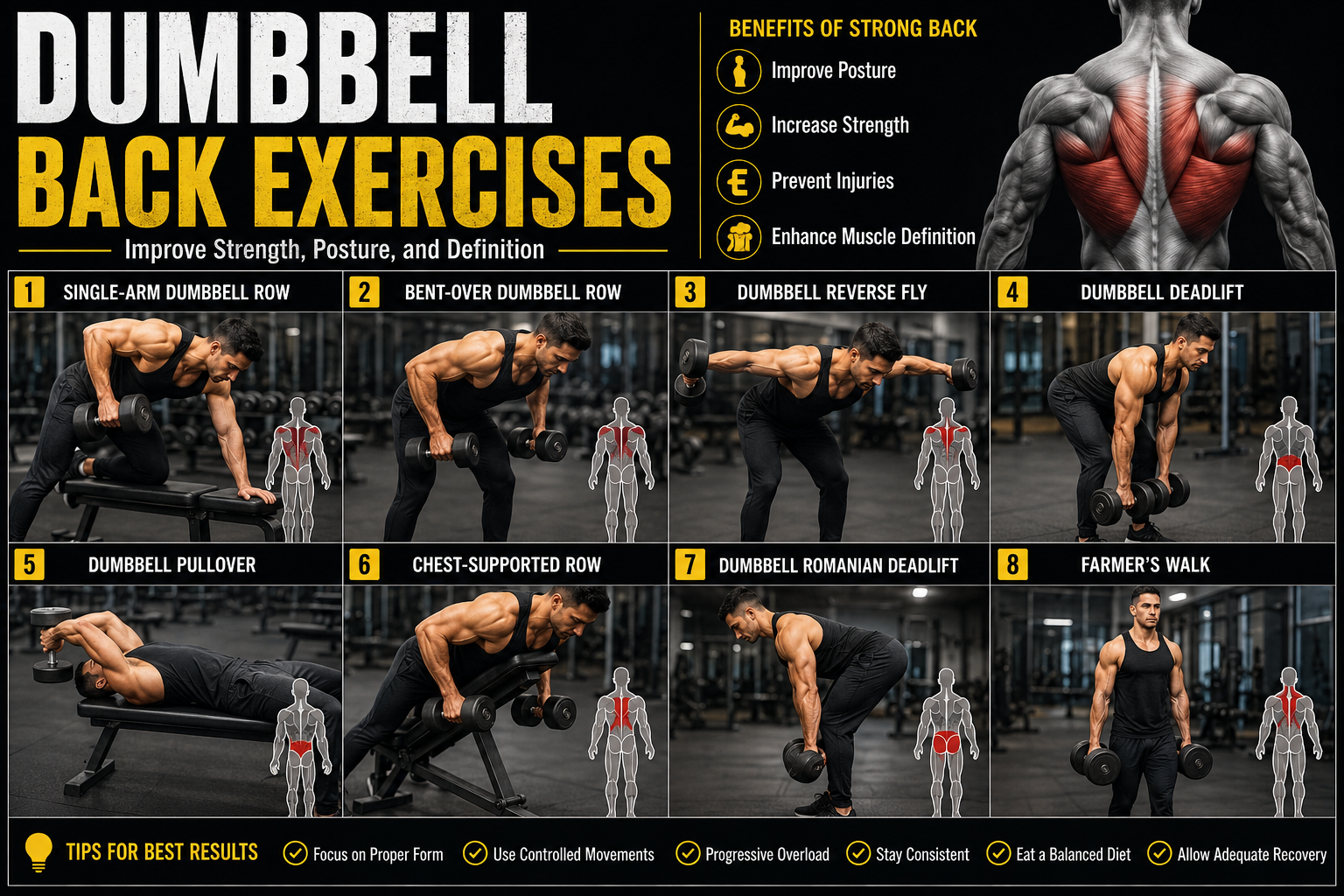
Single-Arm Dumbbell Row
The single-arm dumbbell row is considered one of the most effective dumbbell back exercises for building strength and muscle.
Place one knee and one hand on a bench while holding a dumbbell in your opposite hand. Keep your back flat and pull the dumbbell toward your hip. Squeeze your shoulder blade at the top before lowering the weight slowly.
This exercise primarily targets the lats, rhomboids, and traps while improving balance and correcting muscle imbalances.
Recommended Sets: 3–4
Repetitions: 8–12 per arm
Bent-Over Dumbbell Row
The bent-over row is a compound movement that works almost every muscle in the back.
Stand with your feet shoulder-width apart while holding two dumbbells. Bend forward from your hips until your torso is almost parallel to the floor. Pull both dumbbells toward your waist while squeezing your shoulder blades together, then lower them under control.
Avoid using momentum and keep your spine neutral throughout the exercise.
Recommended Sets: 3–4
Repetitions: 10–12
Dumbbell Reverse Fly
This exercise focuses on the upper back and rear shoulders while improving posture.
Hold light dumbbells and bend forward slightly at the hips. Raise your arms out to the sides until they reach shoulder height before lowering them slowly.
Using lighter weights with proper control produces better results than lifting heavy weights with poor form.
Recommended Sets: 3
Repetitions: 12–15
Dumbbell Deadlift
The dumbbell deadlift strengthens the lower back, glutes, hamstrings, and core while improving overall functional strength.
Stand upright while holding a dumbbell in each hand. Push your hips backward and lower the weights while keeping your back straight. Return to the starting position by driving through your heels and squeezing your glutes.
This exercise teaches proper lifting mechanics and helps protect your lower back during everyday activities.
Recommended Sets: 3–4
Repetitions: 8–10
Dumbbell Pullover
The dumbbell pullover is an excellent exercise for targeting both the lats and chest.
Lie on a flat bench while holding one dumbbell above your chest with both hands. Slowly lower the weight behind your head until you feel a stretch in your lats, then bring it back to the starting position.
Move slowly and avoid bending your elbows too much during the exercise.
Recommended Sets: 3
Repetitions: 10–12
Chest-Supported Dumbbell Row
The chest-supported row reduces stress on the lower back while allowing you to focus completely on the upper-back muscles.
Lie face down on an incline bench while holding two dumbbells. Pull the weights toward your ribs before lowering them slowly.
This exercise is ideal for beginners because it minimizes momentum and encourages proper form.
Recommended Sets: 3
Repetitions: 10–12
Choosing the Right Weight
One of the most common mistakes beginners make is selecting weights that are either too heavy or too light. Choose a weight that allows you to complete your target repetitions with good form while still making the final few reps challenging. If you can easily perform more than 15 repetitions without effort, it’s time to increase the weight. Likewise, if you cannot maintain proper technique, reduce the weight until your form improves. Progressive overload—gradually increasing the weight or repetitions over time—is the key to building muscle and strength safely.
Dumbbell Back Exercises – Improve Strength, Posture, and Definition
Dumbbell Back Workout for Beginners
If you’re new to strength training, it’s important to start with a simple routine that allows you to learn proper form before increasing the weight. Focus on slow, controlled movements and prioritize technique over lifting heavy dumbbells. Rest for 60–90 seconds between each set and perform this workout two times per week, leaving at least one day of rest between sessions.
| Exercise | Sets | Reps |
|---|---|---|
| Single-Arm Dumbbell Row | 3 | 10–12 |
| Bent-Over Dumbbell Row | 3 | 10–12 |
| Dumbbell Reverse Fly | 3 | 12–15 |
| Dumbbell Deadlift | 3 | 10 |
| Dumbbell Pullover | 3 | 10–12 |
This routine targets every major back muscle while also strengthening your shoulders and core. As your strength improves, gradually increase the dumbbell weight or add one extra set to each exercise.
Advanced Dumbbell Back Workout
Once you’ve built a solid foundation, you can challenge your muscles with a higher training volume and heavier weights. Advanced lifters should focus on progressive overload by increasing resistance whenever they can complete all repetitions with proper form.
Workout Plan
- Bent-Over Dumbbell Row – 4 sets × 8–10 reps
- Single-Arm Dumbbell Row – 4 sets × 10 reps per arm
- Chest-Supported Dumbbell Row – 4 sets × 10 reps
- Dumbbell Pullover – 3 sets × 12 reps
- Dumbbell Reverse Fly – 3 sets × 15 reps
- Dumbbell Deadlift – 4 sets × 8 reps
This workout develops both back width and thickness while strengthening the lower back and improving overall upper-body power. Perform this routine once or twice a week depending on your recovery and overall training schedule.
Common Mistakes to Avoid
Even the best dumbbell back exercises won’t produce great results if they are performed incorrectly. Avoiding common mistakes will help you stay safe and maximize muscle growth.
Using Momentum
Many people swing the dumbbells instead of allowing the back muscles to perform the work. This reduces muscle activation and increases the risk of injury. Lift the weight in a controlled manner and lower it slowly.
Rounding the Back
Keeping your spine neutral is essential during rowing and deadlift movements. A rounded back places unnecessary stress on the spine and can lead to lower back pain.
Choosing Weights That Are Too Heavy
Heavy weights may look impressive, but poor technique limits your progress. Select a weight that allows you to maintain perfect form throughout every repetition.
Ignoring the Mind-Muscle Connection
Instead of simply moving the dumbbells, focus on squeezing your shoulder blades together and feeling your back muscles contract. This improves muscle activation and leads to better results.
Skipping Warm-Up
A proper warm-up prepares your muscles and joints for exercise. Spend five to ten minutes performing light cardio and dynamic stretching before starting your workout.
Tips to Maximize Your Results
Getting the most from your dumbbell back exercises requires more than just lifting weights. Your recovery, nutrition, and consistency all play important roles.
Train your back one or two times each week and allow enough time for recovery between sessions. Muscles grow while resting, not while training.
Eat enough protein to support muscle repair and growth. Good protein sources include chicken, fish, eggs, Greek yogurt, beans, and lean beef. Staying hydrated is equally important because dehydration can reduce workout performance and slow recovery.
Focus on progressive overload by gradually increasing the weight, repetitions, or total training volume over time. Small improvements each week add up to significant progress over several months.
Pay attention to your posture throughout the day. Sitting with your shoulders back and maintaining good spinal alignment reinforces the benefits of your workouts.
Finally, be patient. Building a stronger and more defined back takes consistency. Most people begin noticing improvements in strength within a few weeks, while visible muscle definition usually appears after several months of regular training combined with proper nutrition.
Frequently Asked Questions
Are dumbbell back exercises enough to build muscle?
Yes. Dumbbells provide enough resistance to build muscle when combined with proper technique, progressive overload, and a balanced diet.
Can I train my back using only dumbbells?
Absolutely. A pair of dumbbells is enough to perform a complete back workout that targets the upper, middle, and lower back.
How often should I train my back?
Most people achieve excellent results by training their back one or two times per week while allowing at least 48 hours of recovery between sessions.
What is the best dumbbell exercise for the back?
The single-arm dumbbell row is widely considered one of the best exercises because it targets multiple back muscles while improving balance and correcting strength imbalances.
Do dumbbell back exercises improve posture?
Yes. Strengthening the upper back helps pull the shoulders into proper alignment, reducing rounded shoulders and improving overall posture.
How long does it take to see results?
Many people notice increased strength within four to six weeks. Visible muscle growth and improved definition typically take eight to twelve weeks with consistent training and proper nutrition.
Conclusion
Adding dumbbell back exercises to your workout routine is one of the smartest investments you can make in your overall health and fitness. A strong back improves posture, supports better movement, reduces the risk of injury, and enhances athletic performance. Whether you work out at home or in a gym, dumbbells provide a simple, affordable, and highly effective way to build muscle and increase strength.
Exercises like the single-arm row, bent-over row, reverse fly, deadlift, chest-supported row, and dumbbell pullover target every major muscle in your back, helping you develop both width and thickness. By following proper form, choosing appropriate weights, and training consistently, you’ll steadily improve your strength and achieve a more defined physique.
Remember that results don’t happen overnight. Stay committed to your routine, eat a balanced diet rich in protein, and gradually increase the challenge of your workouts. Over time, your efforts will lead to a stronger back, better posture, and greater confidence both inside and outside the gym. With patience and consistency, dumbbell back exercises can become one of the most rewarding parts of your fitness journey.